
 With the dubious inclusion of two new dwarf planets to our solar system's classic starting lineup of nine, the mnemonic for remembering their names just got a whole lot cooler. The new planet order (according to National Geographic Children's Books) is Mercury, Venus, Earth, Mars, Ceres, Jupiter, Saturn, Uranus, Neptune, Pluto, and Eris. Ceres, Pluto, and Eris are considered dwarf planets, though they prefer to be called "little planets". And fourth-grader Maryn Smith has won a contest to come up with a new mnemonic for them: "My Very Exciting Magic Carpet Just Sailed Under Nine Palace Elephants". Sounds like a lost song from Sgt. Pepper, but I like it. In addition to being included in a new National Geographic book, the mnemonic will also be recorded as a song by pop sensation Lisa Loeb, who, despite widespread rumors, did not die in 1996. More details here.
Wednesday, February 27, 2008
Toss a Couple More Planets on the Mnemonic

Tuesday, February 26, 2008
WHAT THE HELL IS THIS?
 The Amateur Scientist is a blog and podcast created by Brian Thompson, a gentleman who has been able to read and write for over seventeen years. Brian and his team of unpaid contributors, sex slaves, and interns provide semi-daily commentary on news relating to science, politics, religion, conspiracy theory, UFOs, mass hysteria, robots, genitals, and robot genitals.
Via the award-pending Amateur Scientist Podcast, this same team of youthful, succulent experts provides weekly audio entertainment for your delicate ears. Previous guests have included notable figures of stage, screen, and letters. Also, a duck. But the meat of the show remains its near-endless deluge of quasi-historical "facts" and semi-racist diatribes about quadroons, who are fine human beings despite their relative shiftiness.
Monday, February 25, 2008
I See Hallucinations
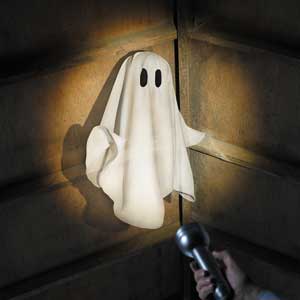 A team of scientists at University College of London (officially the most generic name for an academic institution ever) have conducted new research into the way the human mind tricks itself into seeing ghosts and monsters in the darkness. Read the whole article for a more detailed explanation, but the nutshell here is that in darkness we're more prone to fill out bits and pieces of visual information that we don't really have. In other words, your mind wants to see something complete even if you can't really see anything at all. Which explains why goblins and spooks only tend to hang out in the most dimly-lit rooms. Either that, or they're all fans of the Cure. More details here.
Losing the Faith
 CNN has an unusually interesting analysis of a recent survey conducted by the Pew Forum on Religion and Public Life that shows a growing number of American adults are switching religions to something other than the one they were raised with (or, more grammatically correctly, "the one with which they were reared") or abandoning religion altogether. Of course this is great news. It means that more of us are starting to weigh our options and think for ourselves. It's no wonder that those with a college education are more skeptical of religion, and the same can be said for a generation that's grown up in a world of truly global mass communication. Chances are good that the average American these days has not only been exposed to many ideas about religions via the Internet, but that they have also seen these heretics totally get hit in the nuts while trying to nail a flipkick. More details here.
GIVE US (SOME) OF YOUR MONEY!
 As of October 2009, The Amateur Scientist Podcast has over 3,000 regular weekly listeners, with some episodes reaching as many as 10,000. And the audience grows every week! These are people with time, money, and questionable taste. In other words, they're a valuable demographic.
Each episode of the podcast features an ad break at the halfway point. That's where you may insert your own brand of audio brainwashing. Fellow podcasters may submit 30-second audio promos to run on the show absolutely free. Businesses or cults may have their 30-second message appear on the show for one month (four episodes) for the rock-bottom price of $25.
That's such a value, it's almost sick. Email podcast@amateurscientist.org for details.
FEED YOUR HUNGRY MAW
 The blog feed.
The podcast feed.
Now, you'll never starve! For information, that is*!
*Information is not a form of food.
WE'D LOVE TO HEAR FROM YOU
 And oh, are we ever so available.
The best way to contact us is via good old fashioned, Werther's original email. Podcast@amateurscientist.org is the address.
But if email is a little too stodgy for you, there's also Twitter and Facebook. Here for the former; here for the latter.
PLUS! You may call the Amateur Scientist Hotline and leave an audio message for The Amateur Scientist Podcast. (318) 884-0572. Please, try to keep it short and sexy.
What we're trying to say is, there's no reason for you not to drop us a line. And there's even less of a reason for you not to send us pictures of your nipples.


